

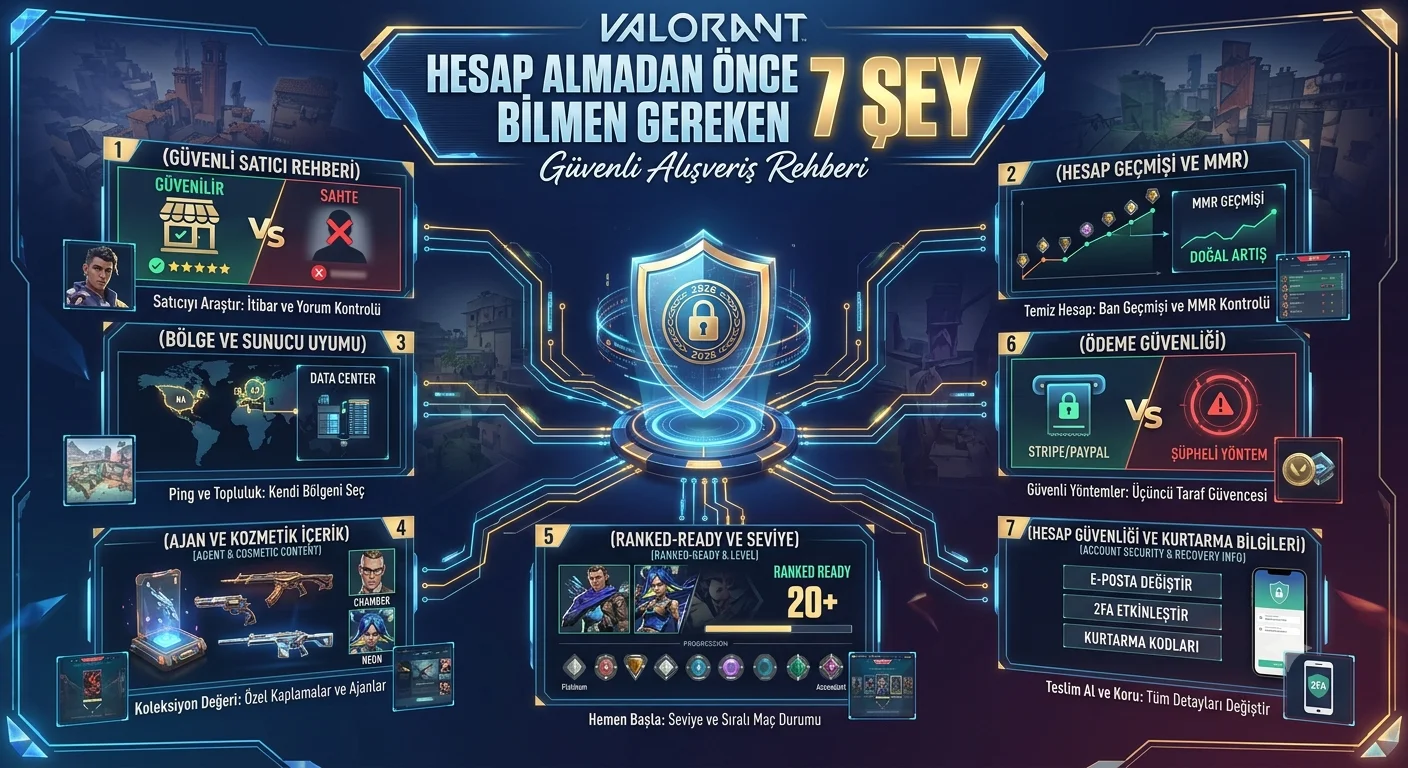
Starting Valorant from scratch, climbing the ranks and collecting the skins you like one by one can take months. That is why buying a ready-made account appeals to many players. But account trading is also an area where, without care, you can lose both your money and the account. In this guide we explain the seven critical points to check before paying for a Valorant account, and why each one matters.
An important note first: Riot Games' Terms of Service do not allow accounts to be sold or transferred. This means there is always a chance that an account you buy could be restricted by Riot. The checks below do not remove that risk, but they greatly reduce the chance of being scammed or having the account taken back.
1. Are the Rank and Match History Real?
Rank is the most advertised detail in listings, but the rank in a screenshot is not always current. In Valorant, ranks are set again through placement matches at the start of each new act/episode. An account sold as "Immortal" may have reached Immortal several seasons ago and be unranked today.
- Ask the seller for the Riot ID (Name#Tag) and check the match history on stats sites such as tracker.gg. If the profile is private, ask the seller to make it public temporarily.
- Check how many competitive matches were played last season. A high rank with very few matches can indicate the account was boosted by someone else.
- Competitive mode requires account level 20. Check whether "competitive-ready" unranked accounts actually meet this requirement.
2. Verify the Skin Inventory Live
Valorant skins are bound to the account; they cannot be transferred to another account or sold on a marketplace like Steam. So most of an account's value comes from its inventory. Do not accept the inventory based on screenshots alone; images are easy to edit or may belong to another account.
- Ask the seller for a short video or live screen share showing the in-game collection screen. Make sure the Riot ID is visible at the start.
- Limited collections (battle-pass exclusives or sets that never return to the store) raise the value; standard skins may reappear in the shop.
- Skin levels (variants, animations, finishers) count too; do not look at the weapon name alone.
3. Account Age and History
Older accounts usually hold more content, but age alone is no guarantee. What really matters is who owned the account and how many times it changed hands. With an account that has been sold many times, the chance of the original owner appearing and reclaiming it through Riot support is higher. Ask the seller directly whether they created the account or bought it themselves.
4. Full Transfer of Email and Login Details
The foundation of account security is getting the email address linked to the account. Riot account recovery runs through email; as long as the email stays with the seller, the account effectively still belongs to them.
- As soon as you receive the account, change the linked email to your own address and verify it.
- Change the password so the seller knows nothing.
- Turn on login verification (two-step verification) on the Riot account.
- If third-party logins (Google, Apple, Xbox, etc.) are linked, remove them and switch to your own method.
If the seller says "I can't give the email, only the password", the account can be taken back later. In that case it is best to walk away.
5. Region: Can an EU Account Be Played in Turkey?
Valorant accounts are tied to the region they were created in. Players in Turkey are in the Europe (EU) region, and the Istanbul servers are part of EU. So if you will play from Turkey, you need an account from the EU region. With an account created in North America (NA), Korea (KR) or Asia-Pacific (AP) you cannot play from Turkey with low ping, and region changes are generally not possible. If the listing does not state the region, ask.
6. Penalty and Ban History
Valorant's anti-cheat is Riot Vanguard. Accounts caught cheating can be permanently closed, and behaviour penalties (chat restrictions, competitive restrictions, queue penalties) are also kept on record.
- Ask the seller to state in writing, in the listing, that the account has never received a cheating penalty.
- When you receive it, log in right away and check that you can queue for competitive and that there is no active restriction warning.
- If the account's history involves suspected cheating, penalties can arrive even after you buy it. Stay away from such accounts, however attractive the price.
7. Always Pay With Protection
Most scam cases happen when payment goes directly to the seller (bank transfer, IBAN, crypto, gift cards). Once the money is sent and the seller disappears, there is no practical way to get it back.
On a secure platform, payment does not reach the seller until the buyer receives the product and confirms. On OyunTicareti this runs through on-site secure payment and the Escrow (protected transaction) service: the payment waits on the platform, you confirm once you have received the account and changed the email, and only then is it released to the seller. If you also keep negotiation and communication in on-site messages, support can review the conversation history if something goes wrong.
Quick Pre-Purchase Checklist
- I have the Riot ID and checked the match history.
- I saw the inventory via video or live screen share.
- I confirmed the account is in the EU region.
- The seller agreed to transfer the email.
- The listing states there is no cheating/penalty history.
- I will pay through the protected system and not leave the site.
If you can say "yes" to all six, you have brought your risk down to a reasonable level. If you hesitate on any of them, do not rush; waiting a few days for the right account is always cheaper than a lost payment. You can browse current Valorant listings in the marketplace.

Comments 0
No comments yet. Be the first to comment!